[Warning: Some of the content in this post is graphic.]
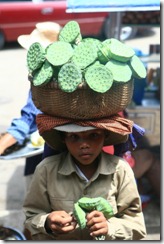
After crossing into Cambodia by bus, the landscape changed almost immediately to flat, flooded rice plains dotted with towering palm trees. It is a weird, but starkly beautiful place. For several hours until we reached the capital, I watched farmers till their paddies with buffalo-drawn carts, white brahma cows graze in pastures, and children chasing chickens. We also passed a few markets, where the most popular items on offer seemed to be lotus seed pods and bags of toasted crickets. Yum! :)
A boy selling lotus seed pods and a woman with a tray of roasted crickets

Our guide had warned us to be careful in Phnom Penh, and my guidebook talked about its “seedy underbelly”. I never saw anything that would make me think this, though. On the contrary, I saw more friendly smiles in Phnom Penh than I’d seen in any city I’d been in so far.
After an introductory visit to Phnom Penh’s sleepy downtown and its social center, the strip of restaurants and bars on the river at Sisowath Quay, I settled in to write some postcards and enjoy a cocktail at the Foreign Correspondents Club (FCC for short). I felt like I’d stepped into Sam’s in Casablanca. The drinks were probably better than Sam’s, too. My favorite was the passionfruit and mint capiroska, with fresh passionfruit. YUM!
A family on a motorbike in Phnom Penh

Monks in a tuk tuk in Phnom Penh

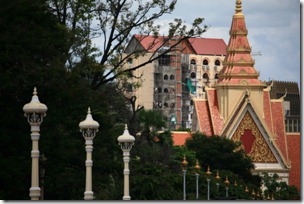
Sleepy Phnom Penh’s skyline and the roof of the Royal Palace

Monks hanging out in Phnom Penh


Details from outside the awesome National Museum in Phnom Penh (photography wasn’t permitted inside)


The next day, we learned about Cambodia’s horrific recent past.
Words aren’t enough to describe what the Cambodian people went through, and there aren’t words horrible enough to describe Pol Pot and his evil regime. For those whose history classes skipped this horrible genocide (mine did), Pol Pot was the leader of the Khmer Rouge, a brutal communist regime that controlled Cambodia from 1976-1979. Under the auspices of turning Cambodia into an “agrarian commune” and purifying the country from western influences, they evacuated the cities and set up labor camps in the countryside to grow rice. Anyone who was a “capitalist”, whether a doctor or a dockworker, was a target for the Khmer Rouge, who killed them slowly by starving the labor camps, and more violently, by torturing and murdering millions in the prisons and killing fields. Simply wearing glasses, knowing how to read, or being the wife or child of a literate person was enough to sentence one to death. No one is sure exactly how many people were murdered by the Khmer Rouge, but most estimates fall between 2 and 3 million, out of a total Cambodian population of just under 7 million at the time. Every Cambodian alive today lost much of their family.
First we visited the infamous Tuol Sleng Prison, codenamed S-21, in the outskirts of Phnom Penh, which was used to hold and torture prisoners until they were ultimately sent to the killing fields. Before the Khmer Rouge, it had been Phnom Penh’s largest school. Now it stands as evidence of the Khmer Rouge’s utter brutality. Mostly it has been left as it was found after the Khmer Rouge were driven out, and blood still stains the walls and floors. For me, the most haunting aspect was the walls and walls of photographs of the Khmer Rouge prisoners. Every single one of them was killed.
A torture room at S-21. The metal implements on the bed are shackles.

The Khmer Rouge documented nearly everything they did. This is a portrait of a girl just after arriving at the prison. The abject terror in her tear-stained face haunted me.


S-21 from the outside. It is netted in barbed wire, so that the prisoners couldn’t commit suicide by jumping from the balconies.


Haunted hallways in S-21.

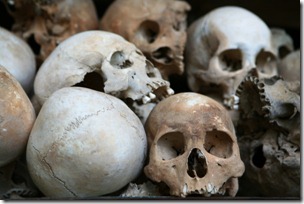
The killing fields of Choeung Ek were even more difficult to visit. Thousands of innocent Cambodians met horrific, tortured deaths here and were hastily buried in mass graves. A few of the graves have been disinterred and the bones recovered are stored in a temple at the site. Many more have been left. Here, shards of bones and teeth still litter the ground, and even the pathways through the site. It is a chilling place. It is not much different than much of Cambodia’s countryside, though, where finding remains is a daily occurrence for farmers. The remains are usually taken to a nearby temple. Cambodians hope that someday they will be able to properly bury the families that they lost.
Skulls and tattered remnants of clothes of some of the Khmer Rouge’s victims at the killing fields of Choeung Ek.

Back in Phnom Penh that afternoon, I saw the city through new eyes. Less than 30 years ago, the city was a burned out shell, its population, culture, religion, and economy completely decimated by the Khmer Rouge. Today it’s a thriving, even bustling place, with museums, galleries, high-end restaurants, and boutiques. And it’s developing at an incredible pace; I saw a ton of new construction of office buildings.
Rising from metaphorical and literal ashes, Cambodia has achieved so much in such a short time, basically my lifetime: it has a functioning government and economy, and its arts, culture, and literatary scenes have been revitalized. The biggest miracle of all is how happy everyone seems – Cambodian people are so quick to smile and work together for a better future. It is the strongest testament to the strength and will of a people that I have witnessed, and I find it profoundly moving.